Guide to private water schemes
This guide provides a summary of the background to private water schemes (syndicates), options for legal structures, types of private water schemes, and an overview about establishing a private water scheme.
GMW recommends that if you are part of an existing or proposed private water scheme you read this webpage in full and seek independent professional advice and assistance from an appropriately experienced and qualified provider.
For further information contact us on 1800 013 357.
Template documents are available at the bottom of this webpage.
What is a private water scheme?
A private water scheme (previously known as a syndicate) is a private arrangement between a group of landowners to share the costs and obligations of installing and operating a private water scheme, comprising pumps, pipelines, channels, etc.
Private water schemes have been operating for many years in GMW’s irrigation districts, and from rivers, streams and bores. Water is used by private water scheme members for purposes including irrigation and domestic and stock.
Some of the existing arrangements are informal and essentially involve handshake agreements between landowners; others are set up using legal frameworks such as community water supply agreements or owners corporations.
What has changed?
In 2007 the Victorian Government introduced a new ‘unbundled’ water entitlement framework for rural water entitlements taken from regulated water systems. These water entitlements (water shares, ABAs, delivery shares, water-use licences/registration) must be owned by legal bodies such as individuals, companies, incorporated associations or owners corporations.
In the same year, the Commonwealth Water Act made it a requirement that syndicate members with irrigation rights must be able to “transform” their water entitlements and hold them in their individual names.
In their current form, many private water schemes are not compatible with the ownership requirements, unbundling or transformation.
GMW has worked with the Department of Energy, Environment and Climate Action to establish guidelines to enable the existing water supply schemes to meet the new requirements.
Landholders in GMW’s region who are members of existing private water schemes or who wish to establish new schemes are now able to do so by using one of three legal structures.
How do the changes impact on new and existing private water schemes?
The changes aim to protect the rights and obligations of all parties by requiring private water schemes to operate under a legal framework and formalising administrative and operational arrangements under Community Water Supply Agreements or Owners Corporation.
The private water schemes arrangements are tailored to meet the needs of the members. Generally, schemes fall into two types: those where none of the members irrigate (supply) and those where some or all of the members irrigate (delivery).
Legal structures
An incorporated association is generally a group, operating not for profit, whose members have decided to give their organisation a formal legal structure. You can recognise an incorporated association by the word ‘Incorporated’ or the abbreviation ‘Inc.’ after its name.
When a group incorporates, it becomes a ‘legal person’ – that is, a legal entity that stays the same even if its members change. It can enter into contracts in its own name; for example, to operate water infrastructure. This protects the individual members of the association from legal liabilities.
The Water Act 1989 makes provision in section 244 for the establishment of a community agreement by which a group of landowners can voluntarily establish a community water supply scheme whose primary purpose is to supply water to farms (“Community Agreement”).
The Community Agreement sets out the mutual objectives, benefits and obligations of the landowners in relation to the delivery of water to their land. It also specifies the operating rules for practical matters such as water usage, losses, metering and ordering and administrative issues including sharing of costs, communicating with members and dealing with disputes.
The Community Agreement is registered on the members’ land titles and is binding on all successors in that title.
TheWater Act 1989 provides that a Community Agreement must provide for the establishment of a committee.
GMW requires that a committee of a Community Agreement (“Community Agreement Committee”) be underpinned by a formal legal structure. It is also a requirement of the Victorian Water Register that the holder of a water share be a legal person or a formal legal entity.
Victorian incorporated associations are registered under the Associations Incorporation Reform Act 2012.
While a Community Agreement Committee must be constituted by more than one person, an incorporated association on its own cannot constitute the Committee. Accordingly, the individual members of the relevant incorporated association constitute the Community Agreement Committee.
Victorian incorporated associations must have at least 5 members so this option may not be suitable for smaller groups.
An owners corporation is generally created when a plan of subdivision containing common property is registered at Land Use Victoria.
The owners corporation is registered on all of the subdivided land titles and each landowner automatically becomes a member of the owners corporation.
Owners corporations must establish a Committee to administer areas of common interest which make them useful in terms of private water scheme arrangements.
An owners corporation is an ideal vehicle for the establishment of a private water scheme in a new subdivision, particularly in the case of rural residential subdivisions. They can also be used for irrigation purposes but become more complex in these cases.
Access is guaranteed via the creation of easements at the subdivision stage. Conditions of water supply or delivery are incorporated in the owners corporation Additional Rules. A Community Agreement is not needed for an Owners Corporation.
It is possible to create an owners corporation for an existing subdivision, but the process is more complex because consent of all title holders and any parties with an interest in the title (e.g. mortgagor) and consent to the model rules must be obtained.
Owners corporations operate under established rules. They use Additional Rules under the owners corporation to set out the arrangements for their private water scheme.
A co-operative is a democratic organisation, owned and controlled by its members for a common benefit. Co-operatives are traditionally based on values of self-help, self-responsibility, equality and solidarity.
Members of co-operatives can benefit from economies of scale through the combined purchasing, distribution or marketing power or influence of the group. They share in the group’s investment and operational risks and losses, as well as its benefits.
Unlike private companies, co-operatives do not have a limit on membership numbers. Their ‘one member, one vote’ system also differs from public companies where voting rights are linked to share ownership.
In a co-operative:
- All members have equal status and voting rights
- No member can hold more than 20 per cent of shares
- All active members can nominate as directors and elect directors
- Capital is used as the group’s common interest
Co-operatives are administered under the Co-operatives National Law, applied in Victoria by the Co-operatives National Law Application Act 2013.
A distributing co-operative (formerly known as a 'trading' co-operative) may distribute any surplus funds to its members. It must have share capital and at least 5 active members. If less than five active members wish to form a co-operative, they must get permission from the Registrar. A co-operative can distribute part of its surplus to members by way of bonus shares, dividends or rebates. When a distributing co-operative is formed, each member must buy the minimum number of shares stated in the co-operative's rules. If the co-operative is wound up, members receive a return on the capital they invest.
A non-distributing co-operative (formerly known as a 'non-trading' co-operative) will use surplus funds to support its activities. Funds are not distributed to members. Non-distributing co-operatives are likely to be more appropriate for a community organisation. A non-distributing co-operative must also have at least 5 active members, but must not distribute surpluses to its members. It can have share capital, but this is optional. If the co-operative is wound up, members can only get back, at most, the original value of their shares in the co-operative’s capital.
Co-operatives can enter a Community Agreement. The purpose of this agreement is to ensure the continued delivery of water to co-operative members if the co-operative ceases operations in the future. Agreements are registered on the property title, providing security for current members, their successors.
Note: Co-operatives may be suitable for large scale irrigation schemes where members propose to put money aside for future replacement and renewals. They are more complex and have substantially higher compliance than incorporated associations. Customers contemplating the use of the Co-operative Model should examine this option carefully in conjunction with their legal and financial advisors.
How do I know which scheme to use?
The type of scheme for you will depend on your particular circumstances. GMW has developed template agreements to cover a range of scenarios and which you can tailor to your situation. Once you fully understand your situation and needs, you then can proceed to formally set up your private water scheme.
The following steps provide general information about doing this.
Step 1: Establish a legal structure for the group
To operate as a private water scheme, the group must establish itself as a formal legal entity. This means that the group of landowners who will operate under the scheme must either register as an Incorporated Association, an Owners Corporation or a Co-Operative.
If an Incorporated Association or co-operative legal structure is selected, then a Community Water Supply Agreement (Community Agreement) is used. If an Owners Corporation structure is selected, then Additional Rules are used. Each alternative covers the rights and obligations of private water scheme members.
More information about the two legal structures is available at the Consumer Affairs Victoria website
Step 2: Ensure all landowners have legal access to water supply or delivery infrastructure
To ensure the rights of all members of a private water scheme and their successors in title are protected, it is a requirement that the water supply or delivery routes to all properties within the scheme are legally protected.
This means that the right of access must be registered on the land titles for all landowners. This can be achieved by either registering an Easement or Access by Agreement on land titles covered by the scheme.
Note: where an Owners Corporation is being used, the access requirement might be satisfied via common property with no further action required.
Registration of easement
Registering an easement on title is a secure way to ensure your access to water supply or delivery infrastructure is protected. The easement provides a person with legal permission to access specific areas of land for installing and maintaining water supply or delivery infrastructure such as a pipeline.
The easement is registered on the land title and remains on the title if the property transfers to another person (unless removed with the consent of the person/s in whose favour the easement is created).
Registering an easement is a highly secure way of creating and preserving access. However, they can be quite costly to establish, requiring detailed survey, survey plans and legal documents as well as lodgement fees.
Registration of Access by Agreement
As an alternative to registering an easement, the parties to a private water scheme may seek to arrange access by agreement under section 234 of the Water Act 1989. This agreement specifies each parcel of land over, or in favour of, which the right of access is created. It also specifies how and when access is given and what activities may be carried out on the land under the agreement. As with a registered easement, an access agreement is registered on the land title and remains on the title when the property transfers to another person (unless removed with the consent of the person/s in whose favour the access agreement is made).
Accesses by Agreements have substantially lower establishment costs when compared to easements.
Step 3: Select private water scheme type
GMW has developed three models for private water schemes that can be used for either existing syndicates or proposed private water schemes.
Each of these models is suitable to unbundle water entitlements in current syndicate operated private water schemes that are situated in regulated water systems.
Under these models, entitlements are transformed from supply agreements, where GMW is the entitlement holder to water share, water-use licence or water-use registration and delivery share (if supply is from an irrigation district).
The following descriptions of each model are focused on community agreements establishing a community water supply scheme as the legal framework.
Important note: The term Community Agreement Committee is used below in the context of the establishment of a Community Agreement. It is noted that an Owners Corporation or Co-operative may be the legal structure used to operate and manage a private water scheme arrangement. Accordingly, the reference to ‘Community Agreement Committee’ should be read as a reference to “Owners Corporation’ or ‘Co-operative’ as applicable and the reference to ‘Community Agreement’ should be read as a reference to a ‘Private Water Scheme Arrangement’ as applicable.
Common features of all models
- The Community Agreement Committee must be a legal entity (options described above).
- The Community Agreement Committee is responsible for all aspects of the common works.
- The relevant member of a Community Agreement is responsible for their own private works.
- All water is ultimately accounted for at the master (parent) meter which is to be located at the source of supply.
- Where supply is from a declared waterway, the Community Agreement Committee must hold a section 67 licence to operate works and the extraction share on behalf of the members.
The supply model (for domestic and stock customers only)
A supply model can only be used if water is not used for irrigation. It is limited to landowners who use water for household use and watering domestic gardens.
Under this model water entitlements (water shares) and seasonal allocations are held and managed by the scheme on behalf of the members. The legal entity holds a water-use registration as the occupier over all the land incorporated in the scheme which authorises the use of water for domestic and stock purposes. The scheme is responsible for supplying water from the GMW off-take to the members (or in regulated diversions customers’ case, from the relevant river).
- Irrigation district customers: GMW prefers that each scheme holds delivery share that is held pro rata on each parcel of land but the scheme may elect not to hold delivery share and pay casual use fees for water use.
- Regulated diversion customers: Where extraction works (pump) are located on a waterway a single works licence is to be held by the legal entity. The general place of take associated with the works licence can be held by the legal entity or apportioned to members in the scheme.
- All: The scheme is responsible for providing services to the members including administering the shared water entitlements, maintaining the delivery infrastructure and operating the supply system. Tasks carried out by the group would include things such as water ordering, water trading, administering shared costs and co-ordinating payment for water consumption and fixed water charges on behalf of the scheme to GMW.
Features of the supply model
- The parent meter that records total usage will be owned, installed (exceptions may be permitted by arrangement that allow self-installation providing it is done to GMW specifications) and maintained by GMW with the Community Agreement Committee or developer meeting the cost of purchasing and installing the meter.
- Child meters are the meters installed to record water use by members. These are compulsory for all new Community Agreements and currently optional for existing Community Agreements. These meters establish each member’s water usage and share of costs. Child meters are likely to be required to comply with the National Non-Urban Metering standards.
- Orders are made by the Community Agreement Committee on behalf of all members. Generally, a standing order or by other arrangement can be made with the local Operations Office.
- The Community Agreement Committee’s allocation account (ABA) must always have a positive balance. Allocation can be sourced from water shares held by the Community Agreement Committee or purchased on the market, and the balance of the account must at all times exceed current usage and orders.
- The Community Agreement Committee is responsible for all water use including the losses incurred in operating the supply and all water supplied to members.
- The Community Agreement Committee will be responsible for payment of all GMW charges. The Community Agreement should specify arrangements for charging members. GMW will not enter into disputes relating to member charges.
- Normal carryover arrangements apply. Dependant on the scheme rules it may be necessary to manage carryover and possible ‘spillage’ of allocation on an individual member basis.
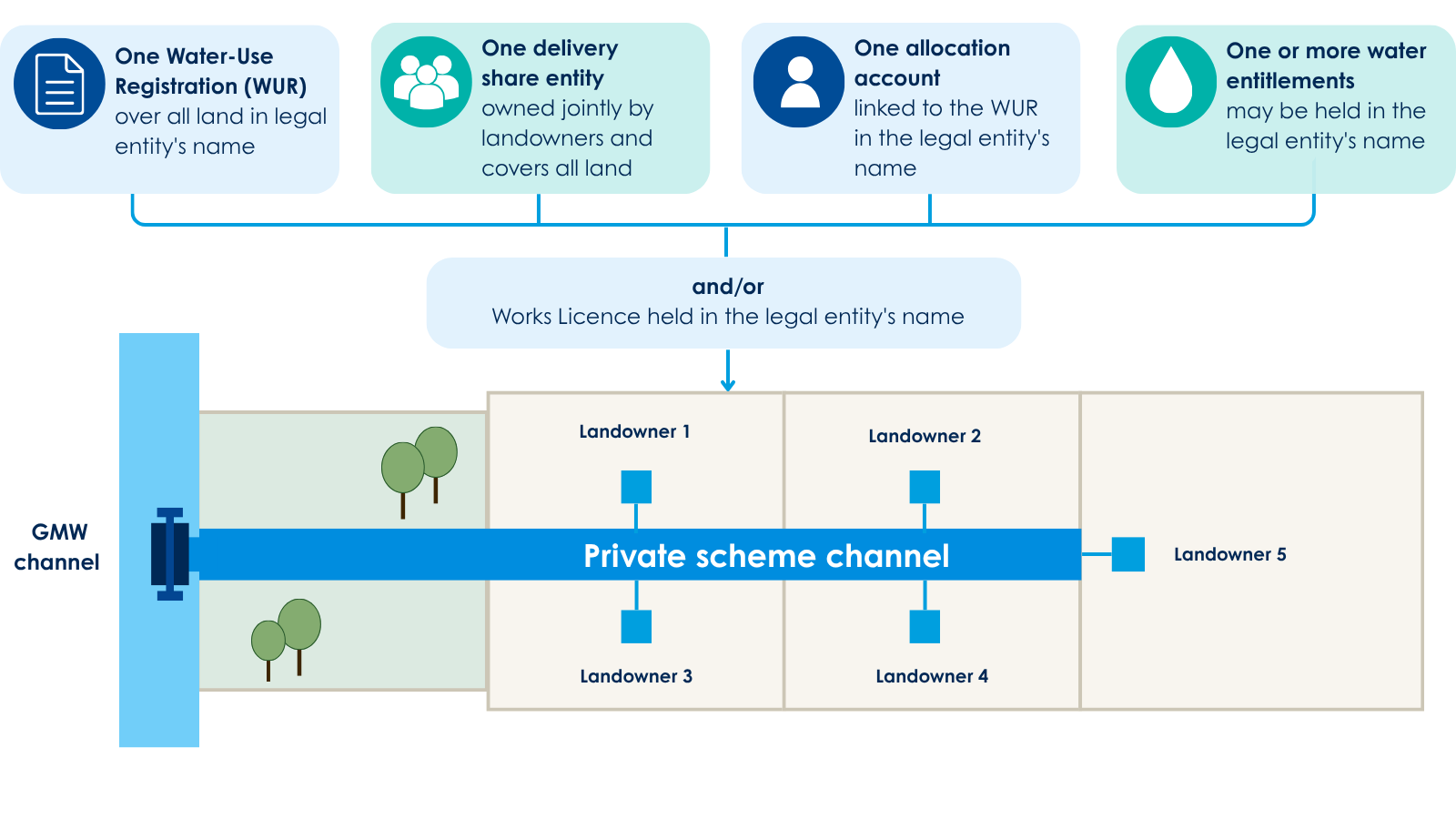 Supply model private water scheme
The delivery model (for irrigation and other purposes)
The delivery model caters specifically for irrigation users but can be used instead of the Supply Model. It is more suited to irrigation enterprises as it provides for delivery losses to be managed separately to each member’s water usage, and for each member to personally hold and manage their own water entitlements and seasonal allocation.
The Community Agreement exists to provide services relating to the common works and to deliver the members' water and is responsible for water losses in providing these services to members.
Under this model, a single water-use registration and delivery share is held to cover losses incurred by the Community Agreement Committee in supplying water to members. (Note: a minimal rate of delivery share can be held to cover loss, but depending upon usage, this may leave the Community Agreement Committee subject to paying casual use rates for some of their usage).
- Irrigation district customers: Each landowner will hold Delivery Shares on their own properties. In addition, a single Delivery Share is to be held over all lands the legal entity delivers water to and is issued in the names of all landowners. The members will be individually responsible for payment of their own delivery shares and the scheme responsible for joint delivery share charges. Under this model each member holds their own Water Share, ABA, water-use licence and a Delivery Share.
- Regulated diversion customers: Where works are on a waterway a single works licence is to be held. The Minister’s policies for managing works licenses require the associated works licence to be held by an individual or an incorporated body.
- All: The scheme provides services relating to maintaining the delivery infrastructure and operating the supply system and is responsible for accounting for water losses incurred in delivering water from GMW’s infrastructure to the individual members.
Features of the delivery model
- The parent meter that records total usage will be owned, installed (as above) and maintained by GMW with the Community Agreement Committee or developer meeting the cost of purchasing and installing the meter.
- Child meters are the meters installed to record water use by members. These are compulsory for all Community Agreements with the exception, at GMW’s discretion, of some low usage existing syndicates. Child meters establish each member’s water usage and share of costs. Child meters are required to comply with the National Non-Urban Metering standards and are used by GMW to determine each member’s usage for compliance, access and billing.
- Orders are placed in accordance with operating terms and conditions.
- Orders can be placed by a member of the Community Agreement that has the relevant authority to order on behalf of the individuals or by the secretary of the Community Agreement Committee. Orders are to be placed at each child service point and should be scheduled (pre-arranged) to ensure water supply is available and taken in a consistent manner.
- Community Agreement members are required to notify the secretary of the Community Agreement Committee of their intention to order to ensure that capacity is available for the delivery. Once approved by the secretary, the order can be placed.
- A meter reading is required prior to a new order being placed in WaterLINE unless alternative arrangements have made and agreed in writing with GMW
- Orders placed should include the volume required at the service point and the water loss component required to deliver the water to the service point. The loss component expressed as a percentage of the order will be agreed at the establishment of the Community Agreement and can be varied based upon actual losses.
- When an order is lodged, a pre-check will be conducted against the Community Agreement member and the Community Agreement Committee’s allocation bank account (ABA) at order lodgement and the ABA must have sufficient allocation to allow the order to proceed.
- The Community Agreement Committee’s ABA must always have a positive balance. Allocation can be sourced from water shares held by the Community Agreement Committee or purchased on the trading market, and the balance of the account must at all times exceed current usage and orders.
- Usage under the Community Agreement is the total of losses incurred in delivering the members’ water and will be calculated as the total metered use at the parent meter less the sum of each member’s use at the child meters. Charges for usage will be billed to the Community Agreement Committee.
- Each member’s water usage will be recorded against their ABA and they will be charged directly for this usage
- The agreement setting up the Community Agreement should specify arrangements for charging members.
- GMW will not enter into disputes relating to water use.
- Carryover arrangements apply independently to the Community Agreement and each of its members.
.png "A diagram showing the delivery model under a private water scheme.") Delivery model private water scheme
Model 3 - Works (pump) share model
The works share model is limited to situations where each property supplied has separate metered supply lines to the source of supply. There is no loss to be accounted for when operating the shared infrastructure. This is generally where a group of meters are located at the source (usually adjacent to the pump outlet).
Under this model, each member independently holds and manages their water entitlements and seasonal allocation. The syndicate exists to provide services relating to the common works (this includes all associated works on Crown land) and to deliver the members' water to the meter used to record each member’s use.
Under this model there is no basis for the syndicate to hold entitlement or delivery share, the syndicate will only hold a licence to operate works. For some existing works where there is a history of meter sharing on a consecutive use basis, use of this model may be approved. Approval would be based upon recording and reporting when each member starts and finishes irrigation or dam filling.
Features of the works share model
- Orders are placed in accordance with operating terms and conditions.
- Orders can be placed by a member of the Community Agreement that has the relevant authority to order on behalf of the individuals or by the secretary of the Community Agreement Committee. Orders are to be placed at each child service point and should be scheduled (pre-arranged) to ensure water supply is available and taken in a consistent manner.
- Community Agreement members are required to notify the secretary of the Community Agreement Committee of their intention to order to ensure that capacity is available for the delivery. Once approved by the secretary, the order can be placed.
- A meter reading is required prior to a new order being placed in WaterLINE unless alternative arrangements have made in accordance with the Community Agreement
GMW delivery arrangements
Delivery of water by GMW to customers who are a party to a Community Water Supply Agreement, an Owners Corporation or a Co-Operative will be in accordance with a Delivery Determination (Terms for Delivery of Water) made from time to time by GMW.
A Delivery Determination is made by the Board of GMW under section 227 of the Water Act 1989 with respect to the delivery of water from its water systems that have been declared under the section 6A of the Water Act 1989.
Landowners' liability
Any persons intending to enter into a private water scheme should seek their own technical, legal, financial and operational advice before signing up to such an arrangement.
Process overview
If you're interested in entering into a private water scheme, you must ensure that you:
- Form a legal entity.
- Establish a scheme between the members for access and delivery purposes.
- Lodge agreements with Land Use Victoria.
- Complete application forms.
- Provide GMW with evidence of the legal body and a copy of the agreement.